
Mobile data for long-term travel is one of those things people know they need to think about, but often don’t think about properly. It tends to sit on a checklist alongside insurance and packing, and only gets real attention when something goes wrong.
Andy and I have been living, travelling, and working abroad on and off for nearly a decade, and one of the most consistent challenges during that time has been staying connected.
Mobile data sounds simple, but when you’re crossing borders regularly and working remotely, it becomes central to how smoothly everyday life runs. It’s something we’ve dealt with badly in the past, and something we’ve often wished we could stop thinking about altogether.
Over the years, we’ve relied on WiFi that barely worked, queued for local SIMs in unfamiliar cities, juggled multiple phone numbers, and added far too much arrival admin to days when we were already tired. When you need reliable access for navigation, banking, work logins, and staying in touch with clients or family, connectivity stops being a nice extra and becomes essential.
Affiliate Link Disclosure: This post contains affiliate links. If you use them to make a purchase, we may earn a small commission at no extra cost to you. As an Amazon Associate, we earn from qualifying purchases. Learn more in our Affiliate Link Disclosure.
Before a trip to Fuerteventura over Christmas, I decided to stop treating mobile data as something I would ‘sort on arrival’ and try Pangia Pass instead.
I’d heard about this new eSIM designed specifically for people moving between countries, rather than short, one-off trips, and it seemed like a good opportunity to test it.
Pangia kindly provided me with a pass ahead of the trip, which meant I could see how it actually worked in real life.
Why Mobile Data Becomes a Problem on Long-Term Trips

On short trips, mobile data issues are easier to brush off. You land, connect to hotel WiFi, muddle through if needed, and it’s usually fine for a week or two. But long-term travel is different.
Staying connected while you’re travelling long-term means asking yourself the same questions over and over. Will my phone work when I land? Can I get directions straight away? Will my bank codes come through? Do I need to find WiFi before I can even leave the airport? How can I get internet for my laptop?
Each of those things feels minor on its own. But when you’re always on the move, they start to stack up. That constant, low-level friction chips away at the ease most people imagine long-term travel will bring.
For digital nomads and location-independent people working remotely, it’s even more noticeable. When your work, income, or clients depend on you being reachable, mobile data becomes part of your basic infrastructure, not a convenience.
Why Relying on WiFi Stops Working

WiFi seems like a good solution until you rely on it day after day.
Accommodation WiFi varies wildly, even in places where you expect it to be good. Public WiFi is often slow or unreliable, and not something you want to rely on for banking or work. Transport WiFi is usually hit or miss at best.
More importantly, WiFi only works once you’re settled. It doesn’t help when you’re navigating a new city, dealing with delays, or trying to sort something quickly while you’re on the move.
International mobile data for travel fills the gaps between places, which is where most of the stress actually happens.
The Long-Term Reality of Local SIMs
Every new country means finding a shop, understanding a new system, dealing with ID requirements, choosing a plan, and setting it all up. Sometimes it’s quick and painless. Other times, it eats into a day you hadn’t planned to spend on admin.
After a few months, this repeated arrival admin becomes exhausting. You put it off, rely on WiFi longer than planned, or juggle multiple SIMs and numbers to stay reachable.
After nearly a decade of travelling and working abroad, it’s this repetition, not the technology itself, that has caused the most friction.
It’s similar to how people often approach long-term travel insurance. It’s something you know you need, but many people don’t properly think it through until they’re already on the road.
Arrival Admin, the Hidden Cost of Long-Term Travel
Arrival days are already full. You’re shattered, carrying bags, navigating transport, finding your accommodation, and trying to get your bearings. Adding mobile data admin into that mix is never going to improve your mood.
You know things would be easier if your phone just worked, but instead you’re queuing in a shop or hunting for WiFi so you can download a map or check your accommodation booking. It’s one of those things that rarely makes it onto a long-term travel checklist, even though it affects almost everything else.
Over time, that becomes one of the most draining parts of travelling this way.
Using Pangia Pass in Fuerteventura

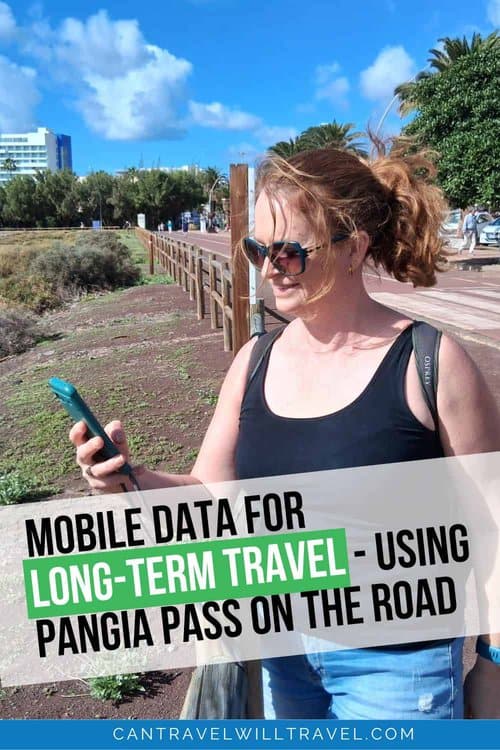
I used Pangia Pass for the first time over Christmas in Fuerteventura, deliberately treating it as a proper test rather than a backup option.
The experience was almost boring, which I mean in the best possible way. I landed, turned my phone on, and everything worked. Maps loaded straight away. Messages came through. Banking apps behaved exactly as they should. I could also use my phone as a hotspot, so my laptop was online within minutes.
There was no airport WiFi panic and no mental note to ‘sort data later’. I didn’t think about mobile data at all once I’d arrived. It was only when I was back home that I realised I hadn’t thought about it at all while I was there.
Compared to other eSIMs I’ve used before, Pangia Pass didn’t feel like something I had to manage. With other options, even when the data worked, I still found myself thinking about coverage, switching plans, or what would happen when I crossed into the next country.
Pangia Pass is different because it’s designed for ongoing travel rather than individual trips. It works across over 100 countries, connecting automatically when you turn your phone on.
Instead of resetting things every time you change country, your phone just behaves normally as you move around. Once it’s in place, there are no new decisions to make or mobile data to sort each time you cross a border, which is what removes so much of the admin on longer trips.
Need mobile data that works across borders without the admin?
Get 10% off your first Pangia Pass subscription (monthly or annual).
Use this link: Pangia Pass eSIM, or enter the code CTWT10 at checkout.
Using Pangia Pass On Future Trips

Fuerteventura was a shorter trip, but I’ve got several trips coming up in 2026, hopefully including Portugal, Spain, Morocco, Kazakhstan, Kyrgyzstan, Malaysia, Cambodia and Japan. Different countries and regions, different infrastructure, and very different expectations around connectivity.
Knowing mobile data is already taken care of removes an entire category of planning and arrival admin. I don’t need to research SIM options for each country or build extra time into arrival days just to get connected. This feels even more important because I’ll likely need to work online on some of these trips. If the accommodation WiFi is patchy, I can simply use my phone as a hotspot and keep going.
For anyone living a location-independent life, whether that’s digital nomads, slow travellers, or people easing into life abroad over multiple trips rather than one big move, that simplicity makes a real difference.
Make Long-Term Travel Easier With Pangia Pass
Long-term travel already gives you enough to juggle. Mobile data doesn’t need to be part of that.
In Fuerteventura, my phone worked as soon as I landed. I was able to just get on with the day without stopping to sort anything out first, which is unusual enough that I noticed it.
If you’re reading this and thinking Pangia Pass might suit how you travel, I have a 10% discount you can use on your first Pangia Pass subscription (monthly or annual).
You can access your discount via this link: Pangia Pass eSIM, or use the code CTWT10 at checkout.
Having Pangia Pass is one less thing to worry about each time I arrive somewhere new. It’s going to be a non-negotiable part of our travel kit in the future.
Read More Live and Work Abroad8 Reasons to Use SafetyWing Travel InsuranceDigital Nomad Guide to Siem Reap in Cambodia Teach English Online – Day in The Life of An Online English Teacher |
Enjoy this post? Pin it for later!
Sponsored disclosure: This post has been created as a paid partnership with Pangia Pass. Read more in our full Sponsored Post Disclosure.

